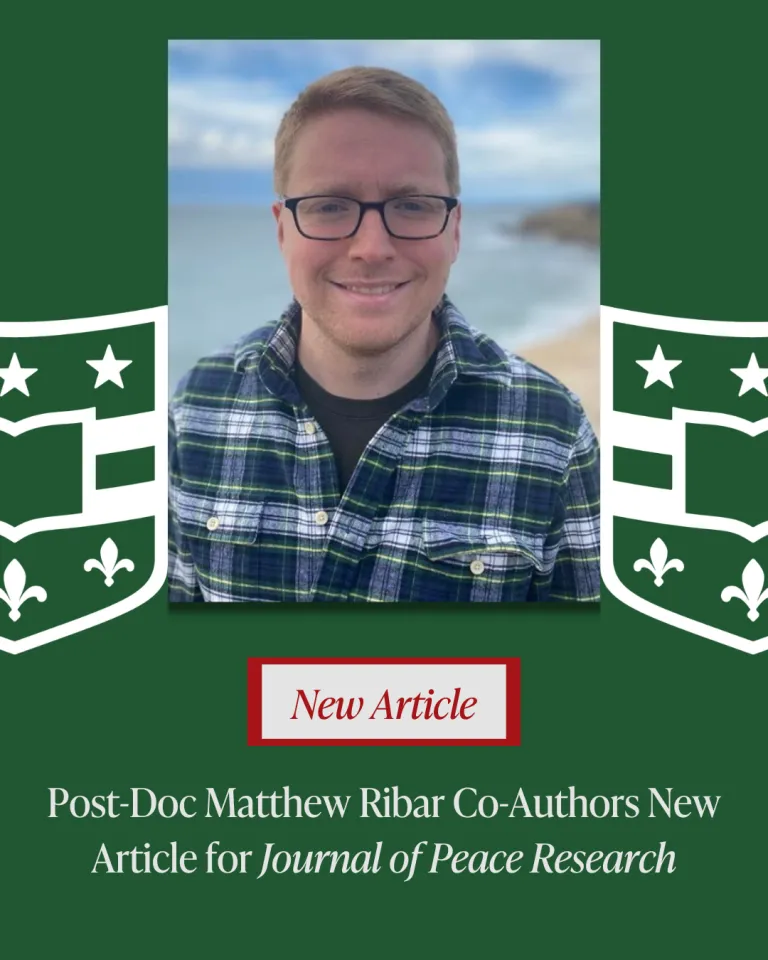
Political Science Post-Doc, and current job market candidate, Matthew Ribar, has co-authored a new article for the Journal of Peace Research.
The article, titled, "Belonging, violence, and natural resource governance: experimental evidence from Mali and Niger," uses a vignette survey experiment of rural household heads in Mali and Niger to examine the effectiveness of community-led and state-led interventions meant to "strengthen natural resource governance institutions." The article "advances our understanding of natural resource governance under institutional pluralism, explores the endogenous relationship between state capacity and armed conflict, and identifies potential limits on the extent to which strengthening local institutions can substitute for low state capacity."
The article was co-authored with Alma Bezares Calderon, Simon Mercer, and Ifeoluwa M. Olawole—three collaborators from Prosper Global, formerly Mercy Corps, (an international NGO).
Read the article abstract below and the full article on the journal's website.
Abstract:
The presence of non-state armed groups in the Sahel complicates effective natural resource governance, which is critical for conflict resolution, economic growth, and climate resilience. In response, African governments and donor organizations have alternatively implemented both community-led and state-led interventions to strengthen natural resource governance institutions. It is unclear, however, what governance strategies will be successful in the face of these challenges. We use a vignette survey experiment administered to 3,607 rural household heads in Mali and Niger to show that (1) respondents consistently believe that a community-led natural resource governance system would be more effective, more equitable, and more resilient to climate change than either the status quo or a state-led system; (2) that members of local ethnic outgroups have greater confidence in community-led and state-led regimes relative to the status quo; and (3) exposure to violence reduces confidence in all proposed systems. This article advances our understanding of natural resource governance under institutional pluralism, explores the endogenous relationship between state capacity and armed conflict, and identifies potential limits on the extent to which strengthening local institutions can substitute for low state capacity.