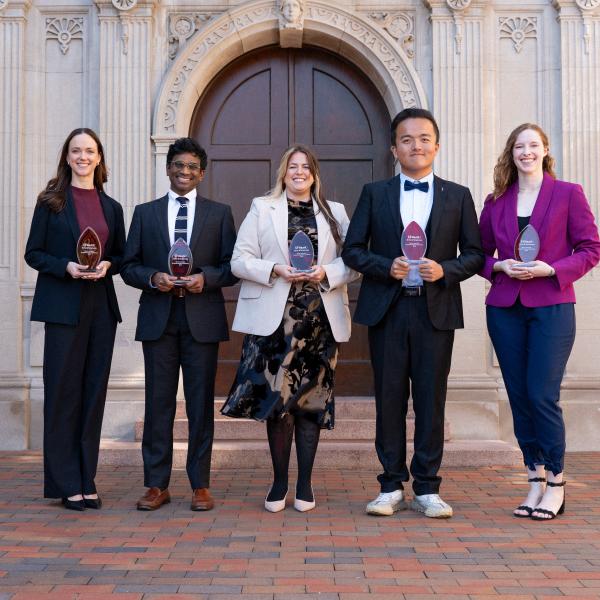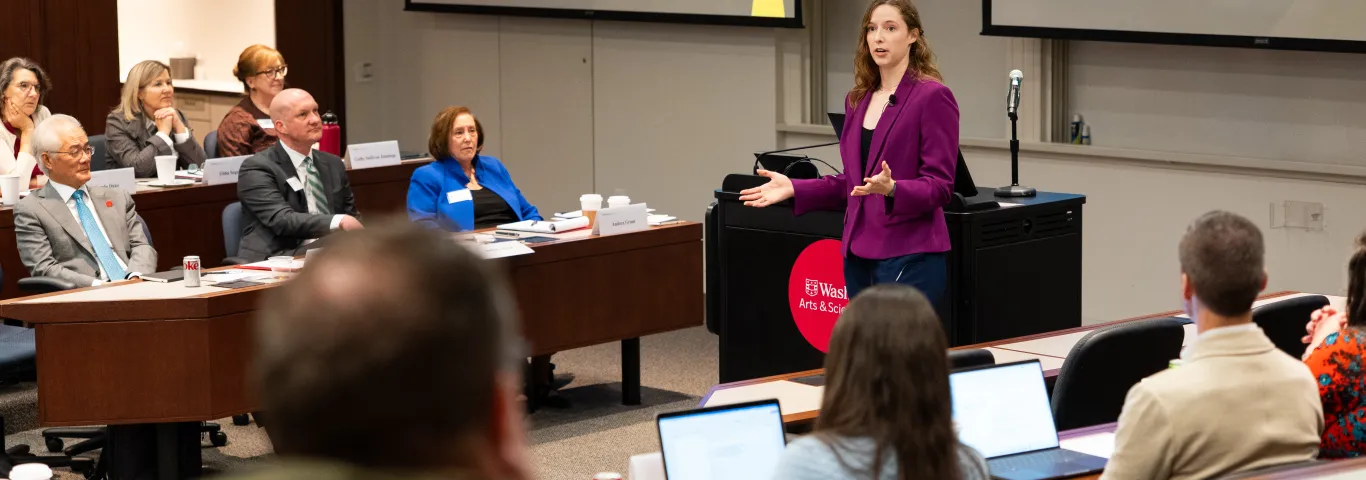
On Oct. 23, finalists for the 2026 Dean’s Award for Graduate Research Excellence had the opportunity to present their work to faculty and university leadership, including members of the Arts & Sciences National Council.
Departments and programs across Arts & Sciences could nominate up to two graduate students for the award, which recognizes outstanding achievements in research or creative practice from the past two years.
Joe Jez, vice dean of graduate studies and the Spencer T. Olin Professor of Biology, introduced the finalists and spoke about the ways in which graduate students research and creative practice contribute to the mission of Arts & Sciences. "We ask graduate students to do something really daunting, which is discover something no one has done before," said Jez. "These students bring their creativity, passion, intellect, just the stick-to-it-ness and resilience."


Finalists

Alex Avery, Department of Political Science
Advisers: David Carter & Diana O'Brien
Presentation: “Fertile Ground: How Ethnic Conflict Shapes Fertility"
Avery is a PhD candidate in the Department of Political Science. Her research examines how political violence and collective identities reshape social relations and political behavior, with particular attention to how gender structures these dynamics. Her work has been invited to revise and resubmit at the journal of Conflict Management and Peace Science, with multiple other works currently under review at major political science journals. She is a fellow with the American Association of University Women, and is a recipient of the 2026 Dean’s Graduate Award for Teaching Excellence.

Akshan deAlwis, Department of Philosophy
Adviser: Matthew McGrath
Presentation: "Desire, Belief, and the Shortcuts of Social Reasoning"
deAlwis is a PhD candidate in philosophy, specializing in epistemology and philosophy of cognitive science. His research examines the nature of reasons and reasoning in humans, animals, and machines. His work has appeared in the Australasian Journal of Philosophy, Mind & Language, and The Oxford Handbook of the Cognitive Science of Belief.

Chun Huang, Department of Physics
Adviser: Alexander Chen
Presentation: “What Happens When We Squeeze Matter to the Extreme?”
Chen is a fifth-year PhD student in the Department of Physics. He received his undergraduate degree from Central China Normal University. His research focuses on neutron stars and pulsars, some of the densest and most extreme objects in the universe. He seeks to understand two fundamental questions: what lies inside neutron stars, and how their powerful magnetic fields shape the radiation we observe. By developing physicsbased models and analyzing X-ray observations, he aims to measure neutron stars' sizes and uncover the properties of matter under conditions that cannot be reproduced on Earth. His research is expanding
to combine X-ray, radio, and gamma-ray observations to build a more complete understanding of neutron stars and their surrounding magnetic environments.

Lauren Johnson, Department of Biology
Adviser: Jonathan Losos
Presentation: “From Individuals to Communities: Impacts of Light Pollution on Mosquito Behavior and Ecology”
Johnson earned her Bachelor of Science in Biology, with a minor in Chemistry, from Trinity University in 2021. At Trinity, she studied the behavioral ecology of birds and anole lizards. She also studied jellyfish through a summer REU at Georgia Southern University and spent a semester studying terrestrial and aquatic ecosystems at the Marine Biological Laboratory. At WashU, Lauren is completing her PhD in Ecology and Evolutionary Biology with support from a National Science Foundation Graduate Research Fellowship. She is advised by Dr. Jonathan Losos in the Biology Department and Drs. Kim Medley and Katie Westby at Tyson Research Center.

Liz Lloyd, Department of Performing Arts
Adviser: Elinor Harrison
Presentation: “How Does Silence Impact Ballet Dancer Learning?”
Lloyd is a dancer, choreographer, educator, and second-year MFA candidate in Dance at WashU, where she also completed her undergraduate degree. She danced professionally with Saint Louis Ballet for eight years and has taught ballet for the past decade. She has presented research at the CORPS de Ballet International Conference, as well as choreographic work at the American College Dance Association and Washington University Dance Theater. Her current research examines communication and agency in classical ballet environments, with the aim of developing more equitable, student-centered pedagogy.