
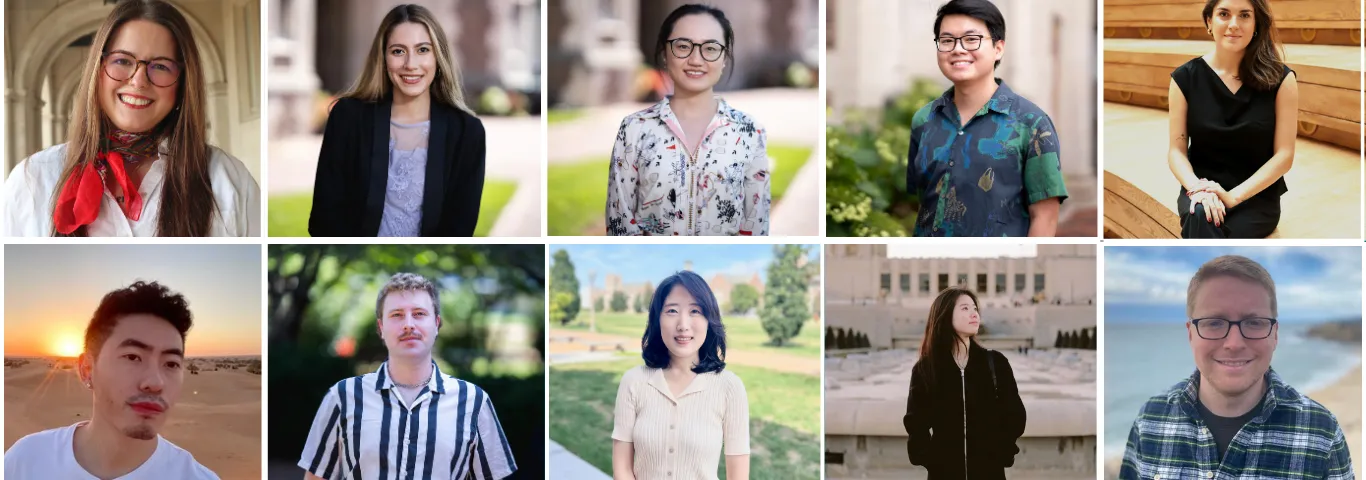
We are pleased to announce our department's job market candidates for the 2026-2027 cycle. These PhD candidates and post-doctoral PhDs have contributed greatly to our department, and we know they will make an incredible addition to departments across the country. The research from this year's job market candidates covers a wide-range of topics including international security, political authority, political communication, political economy of attention, political implications of racial bias, gendered political behavior, and more.
See below for a full list of our job market candidates, their websites, and the focus of their research.
PhD Candidates

Alex Avery
Website: https://www.alexdawnavery.com/
Subfield focus: IR, Comparative Politics, Gender and Politics, Women and Gender Studies
Research focus:
Avery's research examines how conflict and historical legacies shape gendered political behavior, with a particular focus on women’s lived experiences. Using mixed methods, she studies how violence and identity influence family formation, political participation, and gender attitudes. Avery's work bridges feminist political science, conflict studies, and political behavior.
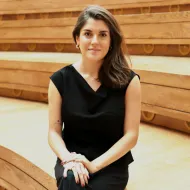
Irene Barrios
Website: https://www.ireneabarrios.com/
Subfield focus: American Politics, Racial and Ethnic Politics
Research focus:
Barrios' research focuses on three topics:
-The politics of race and representation: how racial difference structures who gets represented, by whom, and on what terms.
-The political implications of racial bias: how bias doesn't just live in attitudes but shapes institutions, behavior, and the distribution of power and resources.
-The politics of exclusion: the impulse to deny others a share of what one has, and what that impulse reveals about the boundaries people draw around belonging, worth, and entitlement.

Alexis Jang
Website: https://alexisjang.github.io/
Subfield focus: IR, Comparative Politics, Gender and Politics, Korean and East Asian Politics
Research Focus:
Jang's research is situated in the domestic politics of IR, where they examine how international security environments shape, and are shaped by, citizens' preferences for domestic political leadership. In one line of research, Jang asks whether moments of acute crisis and enduring security threats—war, terrorism, geopolitical rivalry, and democratic backsliding—create opportunities for women in politics or reinforce barriers to their representation. The second line examines the reverse pathway, asking how domestic political leadership choices shape international audiences' perceptions of the country's military strength and the credibility of its alliances. Jang addresses these questions through both cross-national analysis and research focused on South Korea, my primary area of regional expertise.

Ray Lai
Website: https://ruilinlai.com/
Subfield focus: Comparative Politics
Research focus:
Lai's research focuses on two points:
-Judicial repression in autocracies
-Information manipulation and control in both democratic and autocratic contexts

Zion Little
Website: https://lzion96.github.io
Subfield focus: Formal Theory
Research focus:
Little studies the political economy of attention and how it shapes political behavior. Little develops game-theoretic models to understand how communication strategies and signaling structures determine what citizens attend to and how this affects their evaluations of political actors, thereby shaping accountability, electoral outcomes, and public welfare. Little's broader research agenda seeks to explain how attention and information constraints influence democratic governance, institutional trust, and state capacity.
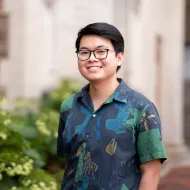
David Nguyen
Website: https://davidqtnguyen.com
Subfield focus: American Politics
Research focus:
Nguyen's research examines political representation by analyzing the behavior of voters and elites across local, state, and national governments. Methodologically, he applies causal inference techniques using large-scale administrative data, surveys, and survey experiments.
Yuan (Cecilia) Sui
Website: https://ceciliaysui.com
Subfield focus: Political Methodology, American Politics, Computational Social Science
Research focus:
Sui's research builds computational methods for studying political communication and uses them to ask how candidates win or lose support in a digital media environment. On the methods side, Sui develops accessible, validated tools: a pretrain-finetune approach to text classification (conditionally accepted at PSRM), a transfer-learning method that detects populist rhetoric across 25 languages without translation (currently under review), feature attribution for interpreting language models applied to political text, and a modular generative-AI pipeline that constructs controlled audiovisual stimuli for survey experiments. Substantively, Sui's job market paper uses that pipeline to show that influencer-style communication lowers perceived competence without producing the parasocial gains it is supposed to deliver, which challenges the common advice that candidates should communicate like social media influencers.

Alma Velazquez
Website: https://amvelazquez.github.io/about/
Subfield focus: IR, International Political Economy, Comparative Politics
Research focus:
Velazquez's research focuses on three topics:
-Sovereignty and political authority under globalization
-The politics of foreign investment, trade, and territorial control
-The long-run political consequences of international shocks
Post-Docs

Matthew Ribar
Website: https://matthewkribar.com/
Subfield focus: Comparative Politics, Political Economy
Research focus:
Ribar studies the political economy of land, development, and conflict with a regional focus on West Africa. Ribar's book project, “Attention Land Predators! Power and Property in Rural West Africa,” explores why formal property rights remain rare across Africa despite their widespread availability. Across projects, Ribar blends in-depth qualitative work with modern empirical techniques from the causal inference, machine learning, and text-as-data literatures.

Hwayong Shin
Website: https://www.hwayongshin.com/
Subfield focus: Public Opinion, Political Communication, Political Psychology
Research focus:
Shin studies how knowledge-generating institutions in democracy earn, lose, and recover public trust. Focusing on the media, government, and science, Shin examines how political crises and individuals’ emotions and experiences shape trust in these institutions, policy preferences, and political engagement in polarized environments. Shin explores these dynamics through journalism’s role in democracy, democratic accountability, and climate and public health policy.